


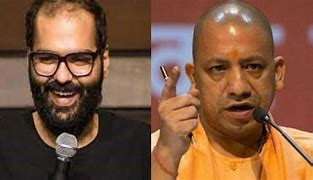
Yogi Adityanath
Table of Contents
Yogi Adityanath, the Chief Minister of Uttar Pradesh, recently made headlines in response to the ongoing row involving comedian Kunal Kamra, where he spoke about freedom of speech and its limits within the Indian constitutional framework. Adityanath’s remarks sparked debates on the boundaries of free expression and whether or not Kamra’s actions were justifiable in the name of comedy. This article delves into his statement, its implications, and the broader discourse around freedom of speech in India.
The Kunal Kamra Controversy
To understand Yogi Adityanath’s position on this matter, it’s essential to first examine the context of the Kunal Kamra row. Kamra, known for his acerbic and satirical humor, has often found himself at the center of political controversies due to his sharp commentary. His most recent brush with controversy occurred after he allegedly insulted a prominent public figure, Arnab Goswami, the editor-in-chief of Republic TV, while aboard a flight. Kamra filmed the incident where he targeted Goswami with insults, calling him out for his purported role in inciting hate and spreading propaganda on his news platform.
The event quickly escalated as Goswami’s supporters, as well as some members of the public, condemned Kamra for what they saw as a breach of decency and propriety. As a result, several airlines imposed temporary bans on Kamra, citing safety concerns and unacceptable behavior. This sparked a larger debate about the limits of free speech, especially when it comes to satirical or provocative content, and whether public figures like Goswami should be treated with a certain degree of respect in public spaces.
Kamra, however, defended his actions, framing them as a legitimate form of political protest and a statement against the state of journalism in India. He argued that his remarks were not personal attacks but rather a critique of what he perceives as an increasingly biased and one-sided media landscape.
Yogi Adityanath’s Remarks
In the midst of this controversy, Yogi Adityanath, a prominent and sometimes controversial leader of the Bharatiya Janata Party (BJP), weighed in with his views. His statement on the issue primarily focused on the concept of freedom of speech and its misuse in contemporary times.
According to Adityanath, people like Kamra had begun to treat the right to freedom of speech as an absolute “birthright” without recognizing the responsibilities and limits attached to it. He implied that some individuals, especially those in the entertainment and media industries, often cross the line by using their platform to deliberately insult or harm public figures, thereby undermining the essence of constructive criticism. Adityanath’s remarks suggested that freedom of speech should not be used as a shield for behavior that, in his view, could be disruptive or harmful to public order.
While he did not specifically mention Kamra by name, it was clear that his comments were a response to the comedian’s actions and the broader culture of outspoken and unrestrained public discourse. Adityanath’s statements evoked a larger conversation about the boundaries of free speech, especially in a diverse and politically charged nation like India.
Freedom of Speech: The Constitutional Right
To understand Adityanath’s remarks, it is important to revisit the fundamental right of freedom of speech and expression in India. The right to freedom of speech is enshrined in Article 19(1)(a) of the Indian Constitution, which grants every citizen the right to express their opinions freely, without censorship. However, this right is not absolute. The Constitution also specifies certain restrictions to this right under Article 19(2), where speech can be curtailed in cases of national security, public order, defamation, and incitement to violence.
The key question that Adityanath’s comments raise is where to draw the line between acceptable speech and harmful speech. Should satirical or critical commentary be seen as a legitimate exercise of free speech, or does it cross the line when it becomes personal or offensive? This is particularly relevant in the case of public figures like Arnab Goswami, who, despite being a target of Kamra’s jokes, is also a representative of a larger media establishment that many accuse of spreading divisive and polarizing content.
The Role of Satire and Comedy in Political Discourse
Adityanath’s criticism of Kamra also raises questions about the role of satire and comedy in political discourse. Satire has long been a tool for questioning authority, critiquing social norms, and challenging the status quo. Comedy, particularly in the form of stand-up, often pushes boundaries and can be seen as a mirror to society, reflecting its flaws, contradictions, and absurdities.
In India, humor has always been an important part of public dialogue. Comedians like Kunal Kamra, who use humor to critique politicians, media figures, and social issues, are part of this tradition. Kamra himself has often stated that his comedy is intended to provoke thought and spark conversations about important political issues.
However, the increasing polarization in Indian society has meant that satire is often seen through a political lens. Comedians and satirists are increasingly becoming targets of criticism from both the government and the public, with accusations that they are sowing division or undermining national unity. In this atmosphere, figures like Adityanath argue that while free speech is vital, it should not be used to undermine social cohesion or disrupt the peace.
Adityanath’s Political Context
Yogi Adityanath’s position on the freedom of speech issue is also reflective of his broader political philosophy and governance style. As the Chief Minister of Uttar Pradesh, one of India’s largest and most politically influential states, Adityanath has taken a strong stance against what he views as the misuse of free speech. Under his administration, there have been instances where political dissenters or critics of the government have faced consequences for their speech, especially when it comes to matters of national security or religious sensitivities.
Adityanath’s approach can be seen as part of a larger trend in Indian politics where the line between legitimate criticism and unacceptable behavior has become blurred. The ruling BJP, of which Adityanath is a key member, often emphasizes the need for national unity and public order, sometimes at the expense of unrestricted free speech.
Balancing Free Speech with Responsibility
In the end, Adityanath’s comments are a call for a balance between freedom of speech and responsibility. While the Constitution guarantees the right to free speech, there is an acknowledgment that this right must be exercised responsibly. This is especially pertinent in a country like India, where the diversity of opinions, cultures, and ideologies makes public discourse highly sensitive.
The debate surrounding Kamra’s actions and Adityanath’s response highlights the complex dynamics of freedom of speech in India. The challenge lies in ensuring that this right is upheld while preventing the misuse of speech to incite hatred, disrupt public order, or harm individuals. As India grapples with these issues, the conversation surrounding the boundaries of free speech will continue to evolve, reflecting the changing political, social, and cultural landscape of the country.
Conclusion
Yogi Adityanath’s remarks on the Kunal Kamra controversy bring attention to a crucial aspect of Indian democracy—the relationship between free speech and responsibility. While Kamra’s actions and humor were seen by some as a valid form of political expression, others, including Adityanath, view them as a misuse of free speech. The conversation is far from over, as it reflects the larger struggle to balance individual freedoms with the collective need for peace, unity, and respect in a pluralistic society.


