


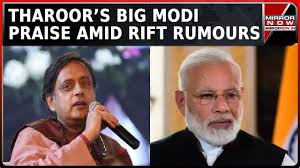
Shashi Tharoor
Table of Contents
Shashi Tharoor’s Diplomacy Praise for PM Modi: Wiping Egg Off His Face or Leaving Congress Red-Faced?
In Indian politics, where party lines often blur into personal loyalties, the relationship between Shashi Tharoor, a senior leader of the Indian National Congress (INC), and Prime Minister Narendra Modi has been an intriguing one. Tharoor, known for his eloquence and intellectual prowess, is often seen as a prominent face of the Congress party’s progressive faction. However, his recent praise for Modi’s diplomatic initiatives has sparked widespread debate, leading many to question whether Tharoor’s comments are a strategic act of diplomacy or a misstep that leaves the Congress party red-faced.
Tharoor’s Compliment: A Diplomatic Acknowledgment
Shashi Tharoor, despite being a critic of Modi’s government on many domestic policies, has not shied away from recognizing the prime minister’s diplomatic successes. In an interview, Tharoor lauded Modi’s foreign policy, particularly his efforts to elevate India’s global standing, strengthen ties with key international partners, and increase India’s influence in multilateral organizations. His praise for the PM’s approach to international relations can be viewed as a candid acknowledgment of Modi’s diplomatic efforts, which have garnered significant international attention.
Tharoor’s comments reflect his pragmatic understanding of international relations. As someone who has held the position of India’s Under-Secretary-General at the United Nations, Tharoor understands the intricacies of global diplomacy. His praise, therefore, is not merely an act of appeasement; it is a recognition of the fact that Modi’s diplomatic initiatives have, to a large extent, put India on the global map in a way that previous administrations have not managed to achieve.
The PM’s efforts in strengthening ties with major powers, including the United States, Japan, Israel, and the Gulf nations, as well as his participation in major international forums like the G20 and the United Nations, have resulted in tangible outcomes. Modi’s “neighborhood first” policy and strategic outreach to South Asian countries also bear fruit in improving India’s regional influence. Tharoor’s acknowledgment of these accomplishments is not just about Modi; it’s about recognizing India’s global rise under his leadership.
Congress Party’s Reaction: A Double-Edged Sword
However, Tharoor’s praise of Modi has raised eyebrows within his own party, the Congress. The relationship between Congress and Modi has often been adversarial, with the opposition party criticizing Modi’s policies on a range of issues, from economic management to minority rights and social policies. Tharoor’s comments, coming from a senior Congress leader, complicate this opposition narrative. For many within the Congress, Tharoor’s praise could be seen as an act of political betrayal.
For the Congress party, which has long positioned itself as the counterpoint to Modi’s leadership, any acknowledgment of Modi’s success risks undermining the party’s opposition narrative. This is especially sensitive considering the internal power dynamics within Congress, where loyalty to party ideology and leadership is a critical factor. Many senior leaders and rank-and-file Congress members have long viewed Modi’s foreign policy, while successful, as an extension of his image-building efforts, largely detached from the domestic concerns that have plagued the country.
Tharoor’s comments could also have repercussions for Congress’s ideological stance. The party’s core base of support often includes those who oppose Modi’s administration on ethical, social, and economic grounds. By praising the PM’s diplomatic endeavors, Tharoor may be seen as diminishing the sharp contrast between Congress and the BJP (Bharatiya Janata Party) that the party has worked hard to maintain over the years. This could alienate a section of Congress supporters who view Modi’s foreign policy success as part of an overall strategy to bolster his domestic narrative, thus obscuring the issues that many believe are more pressing in Indian politics.
Is Tharoor Wiping Egg Off His Face?
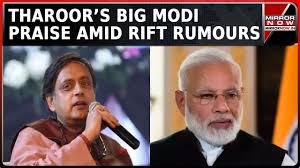
While it is tempting to frame Tharoor’s comments as an effort to “wipe egg off his face,” the reality is more complex. In the Indian political ecosystem, where diplomacy often intertwines with ideology, there is room for nuance. Tharoor’s recognition of Modi’s diplomatic efforts does not necessarily reflect a sudden shift in his political ideology or an attempt to make amends for any past criticisms. It could instead be seen as a demonstration of intellectual honesty, acknowledging the successes of a rival when they are due.
This could also be a tactical maneuver, especially given Tharoor’s nuanced approach to politics. As an individual who has long maintained an independent and thoughtful position within Congress, Tharoor may believe that recognizing Modi’s successes on the international stage will highlight his own credibility as a leader who is willing to look beyond party lines when it comes to issues of national interest. By doing so, he may seek to position himself as a more pragmatic voice within the Congress, one that is open to constructive criticism and solutions, even if it means temporarily stepping away from a combative stance against Modi.
Tharoor, known for his diplomatic skills, may also have calculated that praising Modi’s foreign policy would create a conversation around India’s growing influence on the global stage, something that transcends partisan politics. In a world where soft power and global alliances matter, acknowledging achievements that elevate India’s standing could be seen as putting the country’s interests ahead of political squabbles. Thus, in this light, his praise could be interpreted as an attempt to align with a national interest that rises above party politics.
Does This Leave Congress Red-Faced?
Alternatively, Tharoor’s comments may have left Congress red-faced, particularly given the tense atmosphere within the party and its ongoing struggle to project a unified voice in the face of growing political challenges. As Congress continues to grapple with leadership issues and ideological divides, Tharoor’s praise for Modi could be perceived as emblematic of a deeper divide within the party. Some members of Congress may feel that Tharoor’s remarks weaken the opposition’s position, further fracturing the already fragile unity within the party.
In the larger context of Indian politics, Modi’s popularity among certain sections of the electorate, combined with his global image, has made him a formidable figure for any opposition party, including Congress. Tharoor’s praise could be seen as an acknowledgment of this reality, one that some within Congress may find unpalatable. It may signal to the public that even Congress leaders cannot ignore the international appeal of Modi’s leadership, especially when it comes to the successes in foreign policy.
However, this does not mean that Tharoor’s actions are without merit. His recognition of Modi’s foreign policy achievements could also be seen as a sign of political maturity and an understanding of the nuances of global politics. It might even open the door for other Congress leaders to adopt a more constructive approach to issues of national importance, even when the person leading those efforts is from a different political camp.
Conclusion: A Fine Balance
In the end, Tharoor’s praise of Modi’s diplomatic efforts walks a fine line between constructive recognition and political sensitivity. It’s clear that Tharoor’s comments are not an attempt to undermine Congress but rather an honest acknowledgment of India’s growing global stature under Modi’s leadership. Whether this leaves Congress red-faced or wipes egg off Tharoor’s face depends largely on how the party views the recognition of an adversary’s achievements in the context of national interest.
For Tharoor, the comment may reflect his personal view, while for Congress, it could be seen as a political gamble. Ultimately, the balance between praising a political rival’s success and staying loyal to party ideology is a tightrope that Tharoor has walked carefully. How Congress responds to this incident could provide valuable insights into the party’s broader approach to politics in the coming years.


